
WIFI development board based on ESP-8266EX microcontroller, Arduino compatible with 11 I/O pins and onboard 5V 1A switching power supply supporting OTA wireless upload for IoT projects


WIFI development board based on ESP-8266EX microcontroller, Arduino compatible with 11 I/O pins and onboard 5V 1A switching power supply supporting OTA wireless upload for IoT projects
ESP-8266EX WIFI Development Board with Arduino Compatibility and OTA Wireless Upload
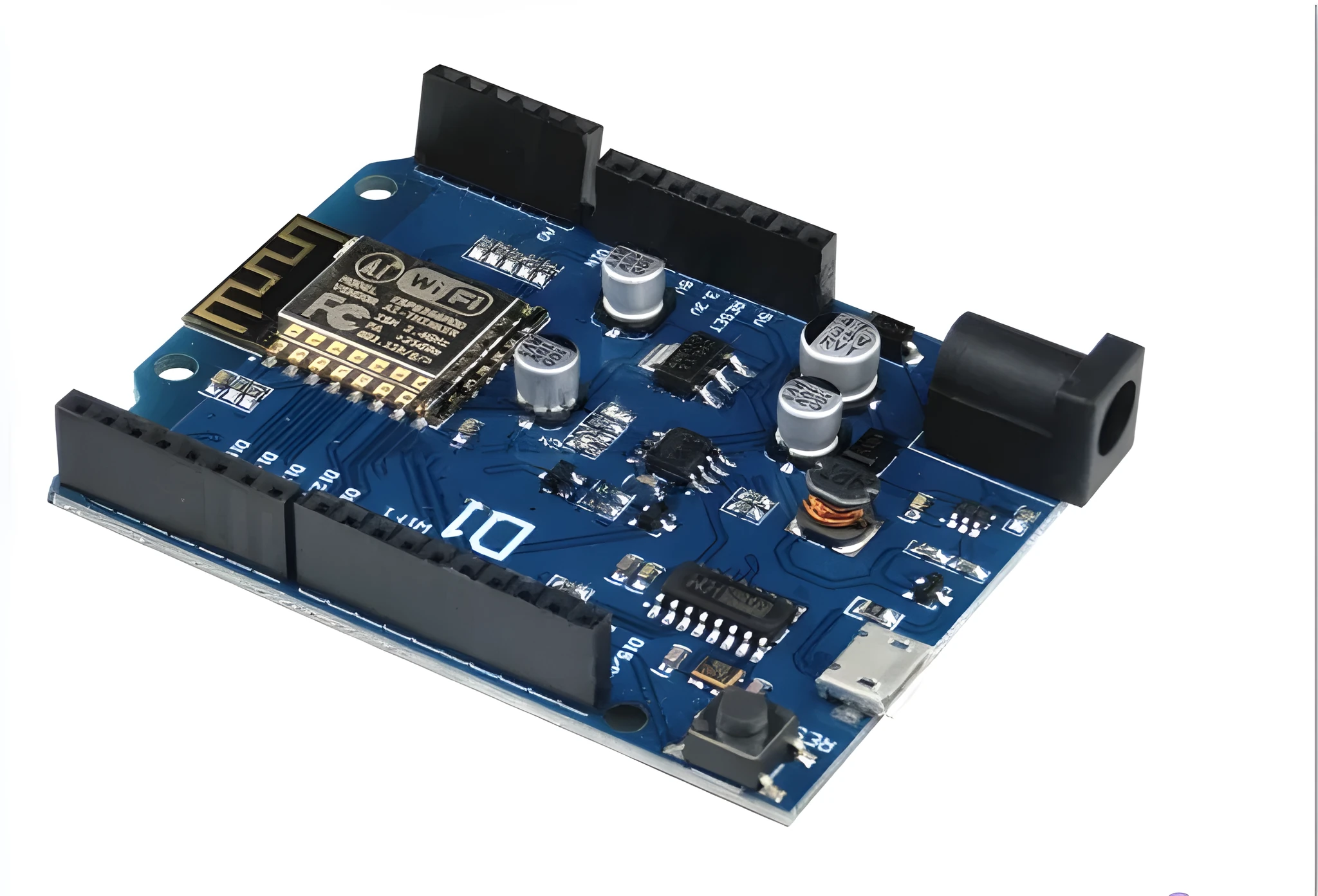
This development board centres around the ESP-8266EX microcontroller, providing a platform for creating Internet of Things projects with wireless connectivity. Compatible with the Arduino IDE development environment, it operates similarly to an Arduino UNO board while incorporating specific features for connected applications. The board supports Over-The-Air wireless upload functionality, allowing remote firmware updates without requiring physical connection to the device. Development begins after installing the necessary hardware packages, with programming conducted through the familiar Arduino interface.
Features and Construction

The board's design incorporates standard development board construction with electronic components arranged for accessibility and prototyping. Its ESP-8266EX microcontroller forms the computational core, while the physical layout provides clear access to input/output connections. The inclusion of an onboard switching power supply simplifies power management for connected peripherals.
Material and Build
Constructed using standard printed circuit board materials with surface-mounted electronic components, this development board follows conventional prototyping board design principles. The black coloured board provides clear visual contrast for component identification and connection tracing. Component placement follows logical groupings with the microcontroller centrally located and I/O pins arranged along the board's edges for accessibility.
Size and Practical Fit
While exact dimensional specifications aren't provided in the source text, the board follows development board conventions that typically balance compactness with accessible connection points. The arrangement of 11 I/O pins along with power and programming connections follows established prototyping patterns. The physical layout accommodates standard breadboarding and prototyping practices common in electronics development.
Uses and Placement
This development board suits various connected project applications where wireless communication forms a core requirement. Its Arduino compatibility lowers the learning curve for those familiar with that ecosystem, while the ESP-8266EX provides dedicated wireless capabilities. The board can serve as both a prototyping platform and a final implementation solution for appropriate projects.
Event or Professional Use
For professional development environments, this board offers a streamlined path to creating connected prototypes and proof-of-concept implementations. The OTA wireless upload capability supports remote updating of deployed devices, reducing maintenance overhead in distributed systems. Development teams familiar with Arduino workflows can leverage existing knowledge while incorporating wireless functionality through the ESP-8266EX microcontroller.
Everyday Home Use
Hobbyists and makers can utilise this board for home automation projects, connected sensors, and Internet of Things applications within domestic environments. The Arduino compatibility allows access to extensive community libraries and examples, while the onboard power supply simplifies powering connected components. Wireless connectivity enables placement flexibility without wiring constraints for data communication.
Benefits and Buying Value
This development board provides specific advantages for wireless project development through its integrated feature set and compatibility with established development tools. The combination of ESP-8266EX wireless capabilities with Arduino programming environment access creates a balanced platform for various connected applications. The inclusion of OTA updating supports long-term project maintenance without physical access requirements.
Reuse and Low Maintenance
The board's design supports repeated programming and prototyping cycles typical of development workflows. OTA wireless upload capability reduces physical connection requirements during iterative development, while the robust construction withstands normal handling during prototyping. The standardised pin layout and connections facilitate reuse across multiple projects with appropriate peripheral connections.
Why Choose This Product
This development board offers a practical combination of wireless connectivity through the ESP-8266EX microcontroller and accessibility through Arduino compatibility. The 11 I/O pins provide adequate connectivity for most sensor and actuator integrations, while the onboard power supply simplifies peripheral power management. For projects requiring wireless communication with Arduino-style development, this board provides a consolidated solution without requiring separate wireless module integration.